History and the Timeless State
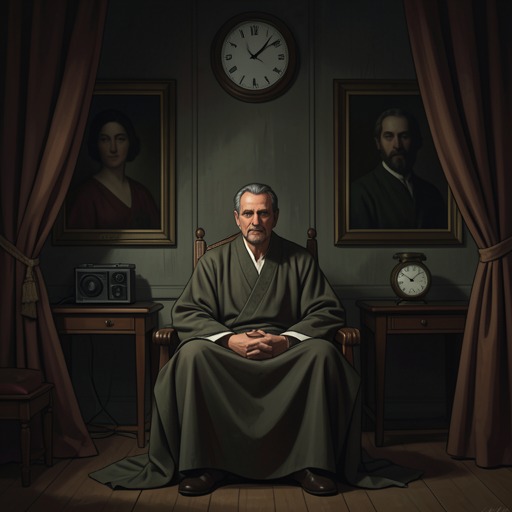
The Satanic VersesHistory and the Timeless State describes the Imam’s project of escaping historical change by replacing it with the unchanging eternity of God. It is at once a political program, a religious ideal, and a dream that takes grotesque shape in Gibreel Farishta’s recurring visions. The Imam presents history as an enemy to be abolished; the dream’s clocks, uprising, and transformed palace make that ambition seem less like release from time than a new form of domination.
The Imam’s rejection of history
The Imam’s opposition to history is built around a contrast between water and wine. He regards water as pure, life-preserving, and morally clarifying, and wine as an intoxicant associated with the Empress Ayesha and the world she represents. He imagines the future as a reversal in which water has its day and blood flows like wine. What begins as the exiled Imam’s fierce language in an overheated apartment is presented as more than private fantasy: his words seem to acquire the power to shape the fate of nations.
The political meaning of this contrast emerges through the Imam’s broadcasts to Desh. Bilal, a convert with a trained and celebrated singing voice, transmits the Imam’s message over surreptitious radio waves from Kensington. His voice carries the Imam’s denunciation of the Empress and his call for revolution. The Imam has chosen Bilal for the authority of that voice, though Bilal initially objects to the suggestion that his sound belongs to the culture of power. The Imam answers that power leaves its habits in people, even those it oppresses. The broadcast thus makes voice itself part of the struggle: Bilal’s public musical authority becomes the instrument for a message against the existing order.
The Imam’s target extends beyond the Empress. He condemns calendars, America, progress, science, and rights as parts of a history he associates with the Devil and with deviation from the religious path. In his account, knowledge was complete when Allah’s revelation to Mahound was finished; further historical change is not improvement but delusion. His revolution promises to remove the veil of history and disclose Paradise. The language offers a total escape from political time, but it also rejects the possibility that knowledge, rights, or social arrangements might change.
A future without clocks
In Gibreel’s vision of the revolution, the Imam connects his followers’ devotion to his claim that he embodies water, fertility, and eternity, while the Empress embodies decay and time. The proposed new order will have no clocks or birthdays; even the word for a clock is to disappear from dictionaries. Everyone, the Imam says, will be born again at the same unchanging age in the sight of God. His ideal is therefore not simply a state without calendars but a world in which human life no longer registers succession, aging, or difference through time.
The dream makes the cost of this vision visible. A slow-moving mass of people advances against armed guards, and the Imam interprets their movement as proof of love. Gibreel challenges that account, seeing the uprising instead as a response to the Empress’s rule. The disagreement exposes a gap between the Imam’s claim to embody the people’s desires and the conditions that have driven them toward him. When the guards are overcome and the people approach the palace, the Imam declares the revolution complete. The palace then becomes the site of an apocalyptic transformation: Al-Lat emerges from it, falls, and vanishes, while the Imam appears monstrous as the people enter. The scene does not settle into a simple image of liberation.
After Al-Lat’s body disappears, the clocks of Desh begin chiming without end, counting beyond ordinary measures of hours and days. Their sound announces the beginning of the Imam’s Untime, but it also contradicts the promised abolition of clocks. The instrument meant to measure historical duration becomes the signal for an hour beyond measurement. This paradox leaves the new order suspended between the removal of time and its extravagant, impossible continuation. The victory of water over wine is proclaimed, yet the apparent end of history arrives through an event that Gibreel experiences as violent and uncanny.
Revelation, authority, and revision
The Imam’s project resonates with another uncertainty in the novel: how religious speech becomes authoritative. In the Jahilia narrative, Mahound describes revelation as a form of listening that seems to arise from within his deepest self. During a moment of doubt, he wonders whether Lat, Uzza, and Manat might be angels and whether accepting a political offer would save the people of the city. At the poetry gathering, he recites verses that appear to validate their intercession. He later concludes that the verses came from the Devil rather than the archangel Gibreel and hurries back to Jahilia to remove them from the record. Yet Gibreel’s account insists that the same voice produced both the verses and their repudiation. The source of the revelation remains unstable even as the narrative shows how urgently Mahound acts to define it.
Salman the Persian’s later recollection sharpens the problem of transmission. After a dream makes him reconsider his role in the earlier revelation, he secretly alters what he writes down for Mahound, changing small phrases and then more consequential wording. Mahound initially fails to detect the changes. Salman treats this failure as evidence that the recorded text can be altered without the Messenger noticing, and eventually leaves Yathrib rather than face discovery. The episodes distinguish among the voice that speaks, the person who receives it, and the scribe who records it, without supplying a stable, external measure that resolves every doubt.
The novel also foregrounds its own literary construction. Its acknowledgements state that the Qur’anic quotations in the book are composites of English versions, with some touches of the author’s own. That statement situates the fictional scenes within an act of literary adaptation: the novel’s treatment of revelation, record, and revision is not presented as a transparent transcript. Read alongside Salman’s alterations and Mahound’s withdrawal of the earlier verses, the note directs attention to the human processes through which words are composed, conveyed, and interpreted.
Gibreel’s dreams and the limits of timelessness
The political story of the Imam and the Empress enters the novel through Gibreel’s recurring night narratives. When one nocturnal story gives way to another, Gibreel briefly hopes that the change means his affliction has ended. But the new narrative resumes its own interrupted pattern, and his image returns to it in the form of an archangel. The Imam’s struggle is therefore not an independent account of a completed revolution: it is also part of Gibreel’s continuing dream experience, whose boundary with waking life remains uncertain.
That frame complicates the promise of escape from history. The Imam seeks to make time stop, while the novel’s stories recur, break off, and begin again within Gibreel’s nights. His vision of a timeless religious state is granted the scale of apocalypse, but it is not made secure by that scale. Its water imagery, broadcast voice, and clockless future give the program coherence; the dream’s contradiction between smashed clocks and ceaseless chimes, together with Gibreel’s uncertainty about what he witnesses, leaves its promised eternity unresolved.